AI, predictions & planning

Don't just see what happened. Know what's next.

Place Performance learns the rhythm of every place to forecast demand, flag risks and recommend actions, then lets you test changes before you make them.

✦Place AssistantLive data

Will the Children's Area hit capacity this Saturday?

Likely, yes. Saturday is forecast to peak at 96% at 11am, driven by the school holiday story time. It stays above 85% from 10:30 to 12:30.

22%48%78%96%90%70%52%30%
9am11am1pm4pm

Recommendation: open the Activity Room as overflow from 10:30 and roster one extra staff member. Confidence 84%

Ask anything about your places…↑

Ask your buildings anything

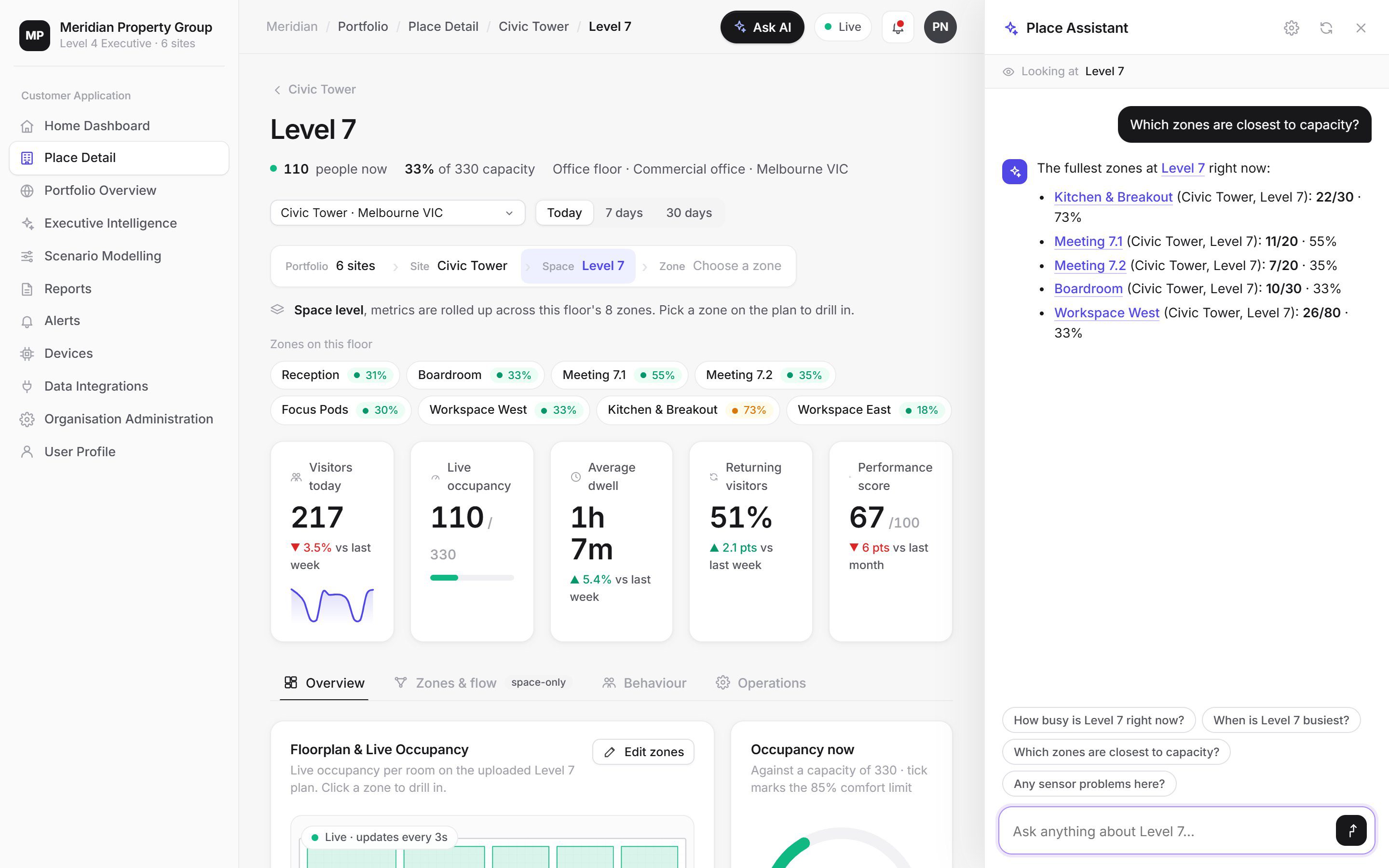
The Place Assistant answers questions in plain English using your live data, links straight to the places it mentions, and knows which screen you are looking at.

Which zones are closest to capacity?
Place Assistant panel open beside a floor dashboard

Forecasting

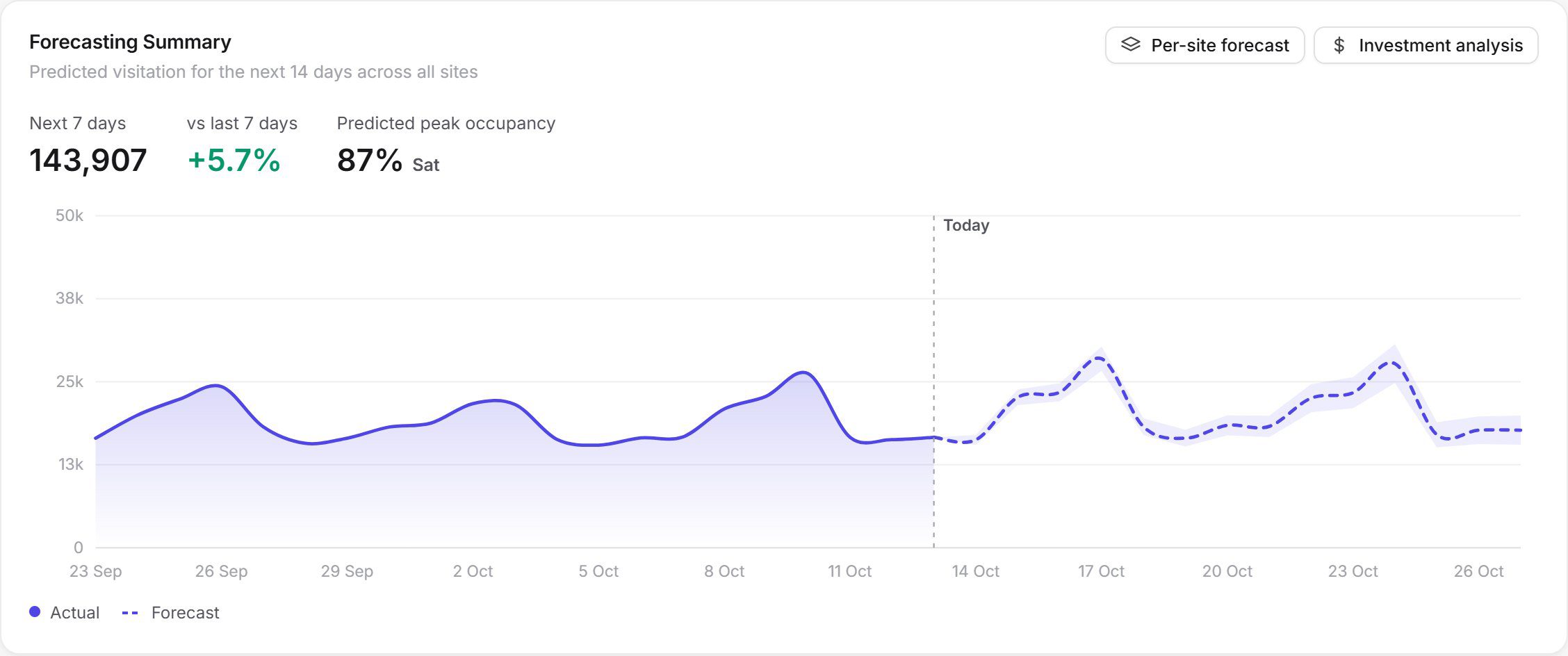
Predicted visitation and occupancy for the weeks ahead, per site, with confidence ranges that widen further out.

Visitation forecast with confidence band

Scenario planning

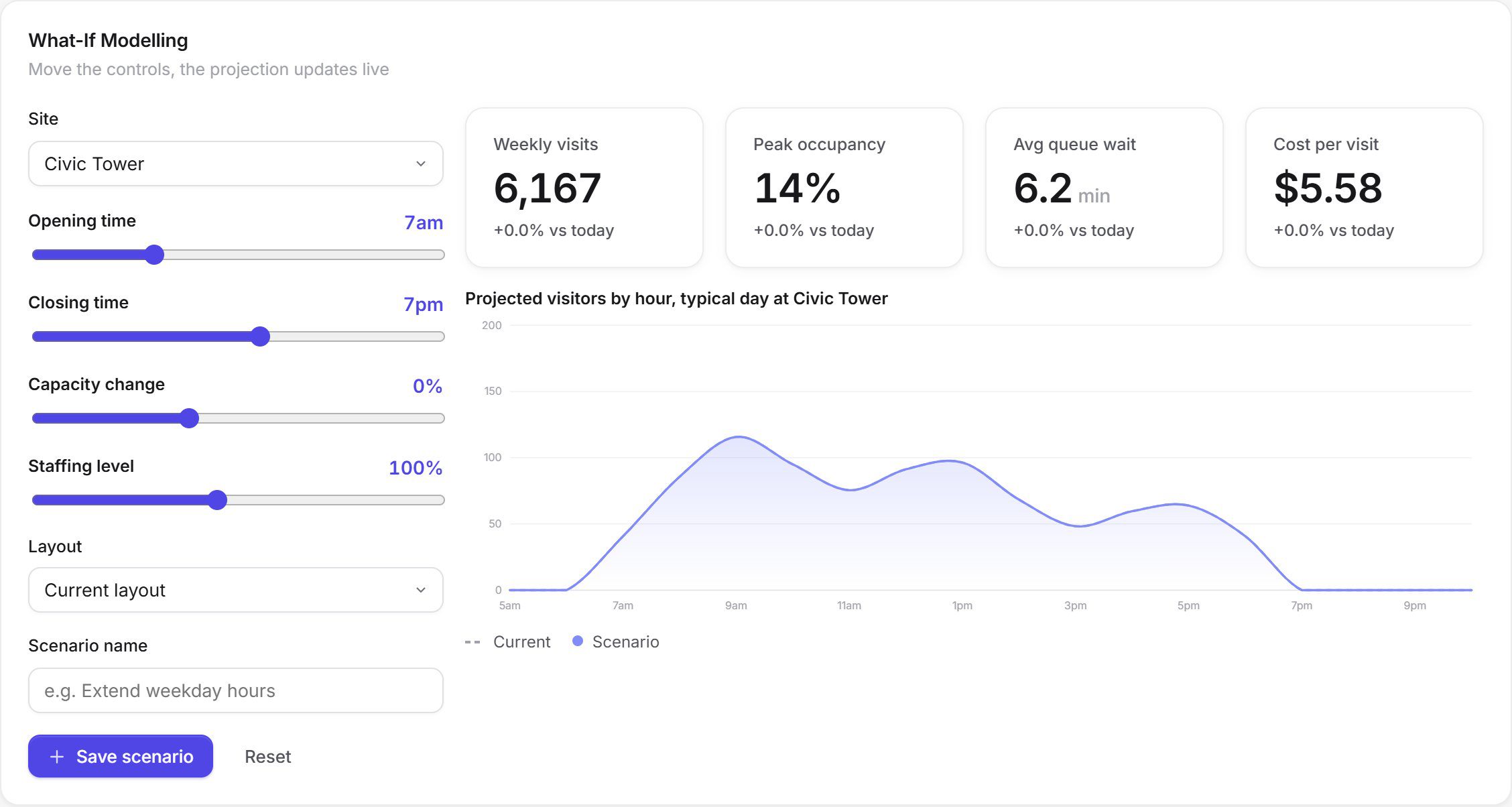
Change opening hours, capacity, staffing or layout and see the projected impact on visits, peak occupancy, queues and cost per visit.

What-if scenario modelling with sliders and projection chart

AI insights, every morning

Plain-language recommendations ranked by impact, each with the evidence behind it and a confidence score.

OpportunityExtend Saturday trading by 1 hour+1,350 visits a week · 86% confidence
RiskChildren's Area regularly over capacity9 breaches in 14 weeks · 92% confidence
EfficiencyLevel 12 under 30% used Mon and Fri≈ $41k a year · 81% confidence

Use the data for planning

From operations to capital decisions.

Staffing & rosters

Match staff to forecast demand and peak periods.

Opening hours

Model the impact of earlier, later or extended trading.

Capital works

Forecast demand before committing to new space, then measure the result.

Investment analysis

Before-and-after views show whether a refit or intervention paid off.

Benchmarking

Compare sites with each other and with anonymised peer cohorts.

Board reporting

Executive packs summarise performance, forecasts and recommendations.

Guide

How AI and forecasting improve planning for places.

Most organisations already know roughly when their places are busy. Forecasting makes that knowledge precise and forward-looking, and AI turns it into specific, ranked recommendations. Together they move decisions from instinct to evidence.

Forecasting visitation and occupancy

Forecasts are built from each place's own history, including time of day, day of week and seasonal patterns such as school holidays and semester breaks. Each forecast comes with a confidence range that widens further into the future, so planners can see both the most likely outcome and the realistic range. A library can see that Saturday story time will push the children's area over capacity, and a campus can anticipate exam-period demand for study space.

Scenario planning before you commit

Scenario planning lets you change assumptions such as opening hours, capacity, staffing or layout and immediately see the projected effect on visits, peak occupancy, queues and cost per visit. Councils use it to test extended trading hours, and retail precincts use it to model the effect of a new entrance or tenant mix.

AI insights every morning

Each morning the platform reviews trends, peaks, capacity breaches and comparisons across your sites, then writes plain-language recommendations ranked by impact. Every insight shows the evidence behind it and a confidence score, so it can be checked rather than taken on trust.

The Place Assistant

The Place Assistant answers questions in plain English using your live data: which rooms are over capacity, when a site is busiest, which sensors are offline, or how this week compares with last. Answers link straight to the places they mention, and it only sees the data your role is allowed to see. Read how data is protected in privacy by design.

From operations to capital decisions

The same intelligence supports rosters and cleaning today and capital works tomorrow. Government agencies use utilisation trends to consolidate property, universities test whether new buildings are really needed, and property owners measure whether a refit paid off. These capabilities are part of the Executive level on the plans page.

FAQ

Questions & answers

How does visitation forecasting work?

Forecasts are built from each place's own history, including time of day, day of week and seasonal patterns, to predict visitation and occupancy for the weeks ahead. Each forecast includes a confidence range that widens further into the future.

What can I ask the Place Assistant?

You can ask questions such as which rooms are over capacity, when a site is busiest, which sensors are offline, how this week compares with last, or what to focus on. Answers use your live data and link directly to the places they mention.

Which AI model powers the Place Assistant?

The Place Assistant uses Claude, a large language model from Anthropic, given a snapshot of the data your role is allowed to see at the time you ask. Contact us for details of data handling for your organisation.

What is scenario planning?

Scenario planning lets you change assumptions such as opening hours, capacity, staffing or layout and immediately see the projected effect on visits, peak occupancy, queue times and cost per visit, then save and compare scenarios side by side.

How are AI insights generated?

Each morning the platform analyses trends, peaks, capacity breaches and comparisons across your sites and writes plain-language recommendations ranked by impact, each with the supporting evidence and a confidence score.

Can it help justify capital investment?

Yes. Forecasts support the business case before you build, and investment analysis compares visitation, dwell and other outcomes before and after a project to show whether it paid off.

See your places in a new light.

Book a 30-minute walkthrough and we'll scope a pilot for one of your sites: sensors, installation, software and insights in one agreement.